Bilingual Household Survival Guide
How to keep Portuguese alive when your child is surrounded by another language — the methods, the science, and the strategies that actually work in real bilingual families.
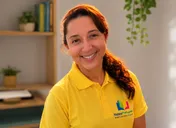
Dra. Carla Regiane Dias
PhD in Portuguese Philology · University of São Paulo
If you're raising a child with Portuguese in a country where another language dominates, you already know the quiet fear. It usually arrives around the time your child starts school, or makes their first English-speaking friends, or one day answers you in English when you spoke to them in Portuguese.
You're not doing anything wrong — and you're not alone.
The slow loss of a minority language is the default outcome — what happens unless a family actively works against it. The dominant language has overwhelming forces on its side. But "default" is not "destiny." The difference between families who keep Portuguese and those who lose it is almost never talent. It's method and consistency.
What the research actually says (and the myths to drop)
✗ Myth: "Two languages will confuse my child or delay their speech."
✓ Reality: False — this is the most persistent myth. The research consensus is clear: bilingualism does not cause language delay or confusion. Bilingual children's total vocabulary across both languages is on par with monolinguals. Bilingualism is a gift to a child's brain, not a burden.
✗ Myth: "Mixing the two languages means my child is confused."
✓ Reality: When a bilingual child mixes languages in one sentence, that's not confusion — it's code-switching, a normal feature of bilingual development. It's a sign of a working bilingual brain.
✗ Myth: "If they understand Portuguese, they're bilingual."
✓ Reality: This is the comforting half-truth that lets the language slip. There's a crucial difference between passive bilingualism (understanding) and active bilingualism (speaking). Understanding is fragile. The goal is a child who produces Portuguese.
The one fact that should guide everything
Input quantity matters, enormously.
A child generally needs to hear a language a meaningful proportion of their waking hours — researchers often cite around a third — to actively acquire and keep it. Your job is to engineer enough Portuguese into your child's life that it clears the threshold for active use.
Choose a method (and actually stick to it)
The specific method matters less than choosing one deliberately and being consistent. Here are the three most common, with honest pros and cons.
One Parent, One Language (OPOL)
✓ Strengths
Clear, simple, and gives the child a consistent, reliable source of Portuguese tied to a specific person. Widely used and well-studied.
⚠ The catch
OPOL alone often doesn't provide enough Portuguese input — one parent present only part of the day may not clear the active-use threshold. It erodes easily from exhaustion.
How to make it work
The Portuguese parent must stay in Portuguese even when the child replies in the other language. OPOL almost always needs reinforcement from media, community, and lessons.
Minority Language at Home (ML@H)
✓ Strengths
Often the most effective method — it maximizes Portuguese input and easily clears the threshold. The outside world reliably provides the dominant language.
⚠ The catch
Requires the non-Brazilian parent to speak Portuguese or be comfortable with the home running in a language they may not fully share — not possible for every family.
How to make it work
If one parent doesn't speak Portuguese, they can still support this approach by learning some themselves and being comfortable with Portuguese happening around them.
Time and Place
✓ Strengths
Flexible and easy to layer into a busy family. Defined pockets (weekends, dinners, the car) are easier to protect than a vague 'speak more Portuguese' intention.
⚠ The catch
Harder to hit the total-input threshold unless the pockets are substantial and genuinely protected.
How to make it work
Make the pockets real and non-negotiable, and stack several so they add up to meaningful daily exposure.
Most successful families combine methods. A common winning recipe: OPOL or ML@H as the backbone, reinforced with time-and-place pockets and heavy Portuguese media and community. Consistency beats perfection.
Young Learners · Ages 5–17 · First class free
Need a real teacher for your child?
Structured teaching builds the literacy and confidence that home alone can't provide. Carla specializes in heritage kids and bilingual households.
The strategies that actually work
These are the practical levers that keep Portuguese alive — the ways you engineer enough input and enough reasons to use it into daily life.
Create real reasons to speak Portuguese
A child keeps a language they need. The single most powerful tool is people your child loves who speak only Portuguese — most often grandparents. The weekly video call with vovó and vovô in Brazil isn't just sweet; it's strategically essential. Protect that call. If grandparents aren't available, build other Portuguese-only relationships — Brazilian family friends, a Portuguese-speaking babysitter, other Brazilian families.
Flood the home with Portuguese media
Music during breakfast, bath time, the car. Brazilian shows, familiar movies dubbed in Portuguese, Brazilian YouTube for kids. Audio stories at bedtime. A child happily watching a show they love in Portuguese is getting hours of input while you do something else. Set it up once and let it run.
Make Portuguese mean culture, not just words
Language survives attached to a culture a child is proud to belong to. Cook Brazilian food. Celebrate Brazilian holidays. Watch Brazilian football. Talk about Brazil with warmth and pride. Plan trips if you possibly can — nothing accelerates a child's Portuguese like a few weeks immersed with cousins who don't speak the other language.
Build a Portuguese community
If your child only hears Portuguese from one parent, it feels like a private family quirk. If they see other families and other kids using it, it becomes real. Seek out Brazilian community groups, playgroups, cultural associations. Other Portuguese-speaking children are especially powerful.
Stay consistent, especially when it's hard
The families who succeed do small things every single day. Every time you let the conversation drift into the dominant language because it's easier, you teach your child that Portuguese is optional. Every time you hold the line gently, you teach them it's real and permanent.
Handling the resistance phase (it's coming, and it's normal)
The resistance phase is normal, it is not a verdict, and it usually passes.
Almost every bilingual child goes through a stage — often around ages five to nine — where they actively resist the minority language. Children who are gently and consistently kept in contact with the language through this phase very often come out the other side grateful for it. Don't let it break you.
Don't turn Portuguese into a battleground. Pressure and shame create negative emotional associations. Keep Portuguese tied to warmth, fun, family, and culture, not conflict.
Lower the stakes, keep the exposure. If your child won't speak Portuguese, keep them hearing it — media, songs, the grandparent calls. Maintain input even when output dips.
Find the motivation that's real for them. A trip to Brazil, cousins they want to play with, a show they love. Connection to something they care about reignites the language far better than obligation.
Be patient and stay the course. The parents who quietly persist — without making it a war — are the ones whose kids keep the language.
The most common mistakes
Giving up too early
Treating the resistance phase, or a period of slow progress, as proof it isn't working. It's a phase. Persist.
Accepting passive bilingualism as the finish line
Being satisfied that the child "understands" and letting active speaking quietly disappear. Understanding is fragile — keep pushing gently for production.
Inconsistency from exhaustion
Letting the Portuguese drift into the dominant language whenever life gets busy. The drift is invisible day to day and devastating over months.
Relying on one parent alone
Expecting one person speaking part-time to clear the input threshold by themselves. Reinforce with media, community, family, and lessons.
Making it a chore
Turning the language into homework and pressure rather than joy and connection. The kids who keep Portuguese associate it with love and fun, not duty.
When to bring in a teacher
Here's the honest limit of even a well-run bilingual household: home exposure builds conversational Portuguese, but it rarely builds literacy. A child can speak Portuguese beautifully and still be unable to read or write it — because reading and writing are taught skills, not absorbed ones.
What structured teaching does that home life can't
Builds reading and writing — the literacy that home conversation doesn't provide
Gives consistency that busy family life can't always guarantee
Treats the child as a real learner with a structured path
Puts Portuguese in a context outside the family — expanding it beyond one parent
Takes the pressure off you — you get to be the parent again
You don't have to bring in a teacher. But for most families, especially once a child is school-aged and literacy matters, it's the single highest-leverage addition — the thing that turns "understands and speaks a bit" into "reads, writes, and owns the language."
Drop the myths. Choose a method and commit to it. Engineer enough Portuguese input to clear the threshold. Hold the line gently through the resistance phase. Bring in real teaching when literacy matters.
You're not fighting a losing battle. You're doing the most important kind of parenting there is: the patient, daily kind that pays off across a lifetime.
Where to go from here
Ages 5–17 · First class free
Young Learners program
Heritage kids and bilingual households where the language is at risk. First class is free — bring your child and see how they respond.
Free resources
Kids' resources library
Songs, books by age, and conversation starters — all free to use this week.
Dra. Carla Regiane Dias
Founder of HappyPortuguese · PhD in Portuguese Philology, University of São Paulo (USP)
Carla has spent over twelve years teaching Brazilian Portuguese to children, heritage learners, and bilingual families around the world. Raising a bilingual child? Share this with the other parent — keeping a language alive is a team effort.