How to Keep Your Child's Portuguese Alive When You Don't Speak It Yourself
A practical guide for parents raising a Portuguese-connected child in a language they don't speak — without guilt, and without pretending to be someone you're not.
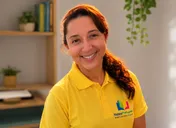
Dra. Carla Regiane Dias
PhD in Portuguese Philology · University of São Paulo
There's a particular kind of worry that brings parents to me. It usually sounds something like this:
"My husband is Brazilian. Our daughter understood Portuguese perfectly when she was three — she'd answer her grandmother on video calls, sing the songs, the whole thing. She's seven now and she only answers in English. My husband works long hours and I don't speak Portuguese at all. I feel like we're losing it, and I don't even know how to help because I can't speak the language myself."
Or this:
"I'm not Brazilian. My wife is. I want our kids to have her language and her culture, but she's the only Portuguese speaker in the house, and honestly her Portuguese with the kids has been slipping into English too because it's easier. I want to help but I feel useless — I can barely say bom dia."
The most important thing
You do not need to speak Portuguese to raise a child who does.
The parent who doesn't speak the language is not a passenger in this process — they're often the difference between a child who keeps Portuguese and one who loses it. Not because of the words they speak, but because of the environment they build, the value they signal, and the consistency they protect.
First, understand what you're actually fighting
When a child grows up surrounded by one dominant language (English) and has only occasional exposure to another (Portuguese), the dominant language wins by default. This isn't a discipline problem or a motivation problem. It's simple arithmetic. The child hears English at school, with friends, on television, in the supermarket — thousands of hours a year. They hear Portuguese from one parent, sometimes, when that parent has the energy. Children are ruthlessly efficient: they optimize for the language that gets them what they need.
Your job — whether you speak Portuguese or not — is to make Portuguese necessary, valued, and consistent enough that the child keeps reaching for it.
Need
Real reasons to use Portuguese — grandparents, friends, travel, pride.
Value
The child senses the language matters deeply to the people they love.
Consistency
The exposure doesn't evaporate the moment life gets busy.
Six strategies that actually work
None of these require you to speak Portuguese. All of them require intention.
Strategy 01
Become the architect, not the teacher
You can't teach Portuguese. Fine — that was never your job. Your job is to architect the environment in which Portuguese survives, and that job doesn't require speaking a word of it. Think of yourself as the producer, not the actor. The Portuguese-speaking parent provides the language. You provide the structure that makes their input actually land: the schedule, the consistency, the routines, the removal of obstacles, the protection of the time.
Make sure the weekly video call with the Brazilian grandmother actually happens, every week, instead of getting endlessly postponed.
Remember that Tuesday is the Portuguese lesson and the iPad is charged and the room is quiet.
Keep the Brazilian books visible and accessible — notice when they migrate to the bottom of the toy box and bring them back.
Keep the Brazilian music playlist going during breakfast even though you don't understand the words.
Protect the Portuguese parent's bedtime-story routine from being crowded out by homework and exhaustion.
"In most families I've worked with, it's the absence of an architect — not the absence of a second speaker — that kills the language. When the non-speaking parent steps into the architect role, the whole system stabilizes."
Strategy 02
Make Portuguese visibly matter to you
Children are extraordinarily sensitive to what their parents actually value — as opposed to what they say they value. If Portuguese is "Dad's thing" that you tolerate but don't engage with, your child absorbs the message that it's optional. If Portuguese is something you — the non-speaking parent — clearly treasure, your child absorbs the opposite message: this language matters to everyone here.
Learn a little yourself, visibly. You don't need to become fluent. But learning ten phrases and using them badly and cheerfully in front of your child tells them that Portuguese is worth a grown-up's effort, that mistakes are normal, and that this is a family project.
Ask your child to teach you. "How do you say 'dog' in Portuguese?" When a seven-year-old gets to be the expert, they have to retrieve and produce the Portuguese — and they feel proud of a language they were starting to treat as a chore.
Celebrate the culture, not just the language. Cook Brazilian food. Put on Brazilian music. Mark Brazilian holidays. Show enthusiasm for the grandparents' country.
"A child keeps a language partly out of love for the people who speak it. When you, the non-speaker, visibly honor that language, you widen the circle of love attached to it."
Strategy 03
Protect the one-parent-one-language system (or rescue it)
The one-parent-one-language system erodes constantly, and it usually erodes from exhaustion. The Brazilian parent comes home tired, the child answers in English, it's easier to continue in English — and over months the Portuguese stream thins to a trickle. The non-speaking parent is actually in the best position to protect it, precisely because you're standing outside it.
Gently hold the Portuguese parent accountable to their own intention. Not nagging — partnership. "Hey, I noticed we've been doing a lot of English at dinner lately."
Create Portuguese-protected zones. Bath time is Portuguese. The car is Portuguese. Sunday breakfast is Portuguese. Defined pockets are easier to maintain than a vague "speak more Portuguese" goal.
Don't let your presence become the reason everyone switches to English. Make it explicitly okay — encouraged — for Portuguese to continue around you. "Don't switch for me. I like hearing it."
"If the family's default is "we speak English when Dad's here," then the more present and involved you are, the less Portuguese the child hears. Flipping that can dramatically increase daily exposure."
Young Learners · Ages 5–17
Looking for a qualified Portuguese teacher for your child?
Dra. Carla specializes in exactly this situation: heritage kids and bilingual households where the language is at risk of fading. The first class is free.
Strategy 04
Outsource the fluency you can't provide
In many heritage-language families, neither parent can fully carry the language load alone. The Brazilian parent has the fluency but not always the time, the patience for teaching, or the formal knowledge of how to build literacy. This is not a failure. It's a normal limitation, and the solution is to bring in help — which lets the non-speaking parent be a parent again, instead of an anxious, under-equipped substitute teacher.
A qualified teacher builds literacy — reading and writing in Portuguese, which conversational home exposure rarely develops. A child can speak Portuguese fluently and still be unable to read or write it.
Structured teaching provides consistency that busy family life can't guarantee. A scheduled weekly class happens whether or not everyone had a hard week.
A teacher gives the child Portuguese in a context outside the family, which expands the language beyond "the thing I do with one parent" into a real language other people use with them.
"You go back to architecting the environment and providing the love and structure, while someone qualified handles the part that actually requires fluency."
Strategy 05
Build the daily exposure that does the quiet work
A child doesn't keep a language on one hour of lessons a week. The language survives in the small, daily, ambient exposure — and almost all of this can be set up by a parent who doesn't speak Portuguese, because it runs on its own once you build it.
Music. Build a Brazilian playlist and let it run during breakfast, car rides, bath time. You don't need to understand it. The child's ear stays tuned to the sounds and vocabulary of Portuguese.
Screen time, redirected. Shift some of that watching to Brazilian children's shows, familiar movies dubbed in Brazilian Portuguese, or Brazilian YouTube channels for kids.
Books, even ones you can't read. Keep Brazilian children's books physically present. The Portuguese-speaking parent or grandparent reads them — you keep them on the shelf and in rotation.
The video-call relationship. The weekly call with Brazilian grandparents gives the child a real reason to speak Portuguese to someone they love. Your job is to make it happen reliably and keep it warm.
"A child needs both output (speaking, which lessons and grandparents provide) and input (hearing and reading, which ambient exposure provides). The non-speaking parent can build almost the entire input layer single-handedly."
Strategy 06
Manage the emotional side — yours and your child's
There's a stage — often around ages six to nine — where many heritage kids actively resist the minority language. They want to be like their friends, they want the easy language, they push back on Portuguese. Parents often read this as "my child is losing interest" and back off, which accelerates the loss. The resistance is a phase, not a verdict.
Don't turn Portuguese into a battleground. Pressure and shame backfire. The goal is to keep Portuguese associated with warmth, play, family, music, and pride — not conflict. Consistency applied gently beats intensity applied through pressure.
Watch your own guilt. Guilt makes you either over-pressure the child or avoid the topic entirely, and both hurt. You are doing something valuable and hard — raising a child connected to a language you don't share, out of love.
Let the child see Portuguese as a gift, not a burden. Frame it as something they get to have — a connection to family, a second world, an ability most people never develop. Children who hear "you're so lucky to have this" internalize a different relationship to the language.
"Children who are gently, consistently kept in contact with the language usually come back around — often becoming grateful for it as teenagers and adults. Don't let a normal phase convince you to give up."
A realistic week, assembled
Here's what a sustainable week might look like in a family where one parent speaks Portuguese and one doesn't — with most of the structure held by the non-speaking parent.
Daily
Brazilian music during breakfast and the school run (set up by the non-speaking parent, runs automatically)
Bedtime story in Portuguese by the Brazilian parent, 3–4 nights a week — the non-speaking parent protects the routine and makes sure it happens
A few times a week
Some screen time shifted to Brazilian content
A short Portuguese audio story in the car
Weekly
Video call with Brazilian grandparents, reliably scheduled and kept warm
Portuguese lesson with a real teacher — the non-speaking parent handles logistics
Ongoing
Brazilian books accessible and in rotation
Brazilian food and culture woven into family life
Both parents visibly valuing the language — one by speaking it, one by honoring it
Notice how much of that the non-Portuguese-speaking parent runs. You are not on the sidelines. You're holding the whole structure together.
The bottom line
Your child's Portuguese isn't being lost because you don't speak it. If it's slipping, it's slipping because of the natural gravitational pull toward the dominant language — and that pull is countered by structure, consistency, value, and love. All of which you can provide in abundance.
The non-speaking parent who shows up as the architect, the protector of routines, the visible admirer of the language, and the one who brings in real help when it's needed is often the reason a heritage language survives. You don't need the words. You need the intention — and you clearly already have that, or you wouldn't have read this far.
Where to go from here
If the missing piece is a reliable, qualified source of Portuguese — someone to build your child's literacy, provide consistency, and treat them as a real learner — that's exactly what Young Learners at HappyPortuguese is for. And if you want practical materials you can start using this week, they're free in the resources library.
Ages 5–17 · First class free
Young Learners program
Children ages 5 to 17, taught by a USP PhD who specializes in heritage kids and bilingual households where the language is at risk of fading. Bring your child — see how they respond.
Free resources
Kids' resources library
Brazilian children's songs, book recommendations by age, conversation starters, and bilingual-household guides — all free to use this week.
Dra. Carla Regiane Dias
Founder of HappyPortuguese · PhD in Portuguese Philology, University of São Paulo (USP)
Carla has spent over twelve years teaching Brazilian Portuguese to children, heritage learners, adults, and families around the world. Raising a bilingual child? Share this with the other parent — especially if they're the one who doesn't speak the language.