Sample CELPE-Bras Tasks with Expert Feedback
Real past exam tasks with Dra. Carla's commentary on what graders look for — and where candidates consistently lose the most points on each task type.
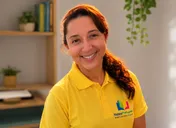
Dra. Carla Regiane Dias
PhD in Portuguese Philology · University of São Paulo
The CELPE-Bras blocks a real life goal for most people who sit it — naturalisation, a medical licence through Revalida, a university place. Yet the most common reasons candidates underperform have nothing to do with how much Portuguese they know. They have to do with misunderstanding how the exam is graded. This guide walks through each task type with real examples, shows you exactly what the raters reward, and names the mistakes that cost points every single cycle.
How the exam is actually scored
Before the tasks, understand the machine that grades them. Almost every avoidable point loss traces back to misunderstanding one of these four facts.
Two parts.
A written part (4 integrated tasks, up to 3 hours) and a 20-minute oral. You need both; one strong part cannot fully rescue a weak one.
0–5 per task.
Each written task is scored 0 to 5 by two independent raters. Tasks reward communicative success, not grammatical perfection.
Three kinds of adequacy.
| Axis | What it measures |
|---|---|
| Adequação contextual | Did you understand the command — who you are, who you're writing to, the genre, and the purpose? This is the make-or-break axis. |
| Adequação discursiva | Is the text cohesive and coherent — does it hold together and flow for the reader? |
| Adequação linguística | Is your vocabulary and grammar effective for the genre and reader? Errors count only insofar as they hurt communication. |
Four certification levels.
There is no "beginner" certificate and no simple pass/fail:
Foreign doctors seeking Revalida typically need at least Intermediário Superior. Confirm the specific level your institution requires.
Dra. Carla says
Read this twice — the CELPE-Bras does not test grammar in the abstract. It tests whether you can do things with Portuguese: inform, persuade, instruct, argue, for real readers. A grammatically clean text that answers the wrong command scores worse than a flawed text that nails it.
Tarefa 1 — Vídeo
Listening (video, played twice) → written text
Sample enunciado (command)
Na condição de professor(a), depois de assistir ao vídeo sobre a comemoração do Ano Internacional das Línguas Indígenas, escreva uma matéria para o site da escola. Seu texto deverá informar sobre a comemoração, abordar a situação das línguas indígenas no Brasil e apresentar iniciativas propostas para preservá-las.
Adapted from the real 2019/2 exam. You watch a short video twice, taking notes, then write an informative article for a school website.
| Who you are | A teacher at the school |
| Who you write to | The school community — students, parents, staff |
| Genre | Matéria / informative article (needs a title, neutral-to-engaged register) |
| Purpose | Three objectives: (1) inform about the celebration, (2) describe the situation of indigenous languages, (3) present preservation initiatives |
✓ What graders reward
- ✓Re-authoring the video's content in your own words, not transcribing it
- ✓Covering all three sub-objectives in the command
- ✓Article conventions: a clear title, an informative lead, organised paragraphs
- ✓Integrating concrete facts from the video (figures, examples) to build credibility
✕ Where candidates lose the most points
- ✕Missing the second viewing's details, then inventing facts to fill gaps
- ✕Delivering only one or two of the three objectives (this caps the contextual score)
- ✕Copying chunks of the narration verbatim ("cópia" is penalised)
- ✕Writing a generic essay that ignores the school-website context and audience
Dra. Carla says
Tarefa 1 is where listening meets writing, and panic. Use the first viewing to grasp the gist and the second to capture numbers and names. The single biggest predictor of a 5 here is not your grammar — it's whether you hit every part of the command in the right genre.
Worked example — 5/5 Avançado Superior
A candidate's response to the Tarefa 1 task above (indigenous languages, 2019/2) was awarded 5/5 — Avançado Superior by INEP's two independent raters — despite containing more than a dozen grammar errors. Why? Because it respected the command completely and re-authored the content in the candidate's own words.
Grammar slips that did not sink the score:
| In the answer | Should have been |
|---|---|
| "a UNESCO festaja e comemora…" | festeja |
| "…indígenas moram em Brasil e a metade delas…" | moram no Brasil e a metade deles |
| "Expertos das universidades brasileiras…" | pesquisadores |
| "Outro importante inciativa…" | Outra importante iniciativa |
The lesson
Raters praised the "maneira autoral e autônoma" — the authorial, independent way the candidate explained things in their own words. Grammar matters, but fulfilling the enunciado in the right genre matters far more.
Tarefa 2 — Áudio
Listening (audio, played twice) → written text
Sample enunciado (command)
Você ouviu, em um programa de rádio, uma reportagem sobre o desperdício de alimentos no Brasil. Como voluntário(a) de uma ONG que combate a fome, escreva um texto para o boletim da organização, explicando o problema e propondo atitudes que os leitores podem adotar no dia a dia.
| Who you are | A volunteer at an anti-hunger NGO |
| Who you write to | Readers of the NGO's newsletter — the general public |
| Genre | Newsletter text / informative-persuasive piece |
| Purpose | Explain the problem and propose concrete everyday actions (two moves: inform + mobilise) |
✓ What graders reward
- ✓Anchoring claims in what the audio actually said (data, causes, examples)
- ✓Shifting register to address ordinary readers warmly and clearly
- ✓A clear structure: problem → why it matters → what you can do
- ✓Using cohesive connectives (além disso, por isso, dessa forma) to guide the reader
✕ Where candidates lose the most points
- ✕Mishearing key numbers or causes and writing vaguely to hide the gap
- ✕Explaining the problem but forgetting the call to action (half the purpose)
- ✕Listing actions with no link to the report's specific points
- ✕Over-formal, abstract language that doesn't fit a community newsletter
Dra. Carla says
Audio is the great equaliser — strong readers suddenly struggle. Train with Brazilian radio and podcasts at natural speed, not slowed-down classroom audio. On exam day, write down the three or four hard facts you catch immediately; they become the backbone of a credible text.
Tarefa 3 — Texto escrito (jornal)
Reading → written text
Sample enunciado (command)
Com base em uma reportagem de jornal sobre o aumento do tempo de tela entre crianças, e na condição de pediatra, escreva um folheto informativo a ser distribuído na sala de espera do posto de saúde, orientando os pais sobre os riscos e sugerindo limites saudáveis de uso de telas.
| Who you are | A paediatrician |
| Who you write to | Parents in a health-clinic waiting room |
| Genre | Folheto informativo (leaflet) — short, scannable, directive |
| Purpose | Orient parents about risks and suggest healthy screen-time limits |
✓ What graders reward
- ✓Transforming the article's information into advice for parents (new purpose)
- ✓Leaflet conventions: a hook title, short blocks, an approachable but expert tone
- ✓Selecting only the facts relevant to this audience and goal
- ✓Practical, actionable recommendations a parent could follow tomorrow
✕ Where candidates lose the most points
- ✕Paraphrasing the article instead of acting on it (no genre transformation)
- ✕Writing dense academic paragraphs unsuited to a waiting-room leaflet
- ✕Giving risks but no concrete limits, or vice versa
- ✕Adopting the journalist's voice instead of the paediatrician's
Dra. Carla says
Tarefa 3 tests a subtle skill — taking information made for one purpose and re-tooling it for another. Candidates who simply "retell" the article, however accurately, miss the point. Ask yourself before writing: what does my reader need to do after reading this?
Tarefa 4 — Texto escrito (revista)
Reading → argumentative text
Sample enunciado (command)
A partir de um artigo de revista que defende o fim do trabalho presencial em favor do home office, escreva uma carta do leitor à revista, posicionando-se a favor ou contra essa ideia e sustentando seu ponto de vista com argumentos.
| Who you are | A reader of the magazine |
| Who you write to | The magazine and its readership |
| Genre | Carta do leitor (reader's letter) — greeting, stance, arguments, close |
| Purpose | Take a clear position (for or against) and sustain it with arguments |
✓ What graders reward
- ✓A clear, early thesis and a position held consistently to the end
- ✓Engaging directly with the source article's claims (agreeing or rebutting)
- ✓Two or three developed arguments, not a list of unsupported opinions
- ✓Letter conventions and a register that respects the public, formal interlocutor
✕ Where candidates lose the most points
- ✕Staying neutral or merely describing both sides (no defensible position)
- ✕Arguing in a vacuum, never referencing the article you're responding to
- ✕Asserting opinions without reasons, examples, or consequences
- ✕Drifting position mid-text, which undermines the whole argument
Dra. Carla says
Tarefa 4 is where the certificate is often won or lost. The exam is not asking what you think is "balanced" — it is asking you to argue. Pick a side in the first two lines, even if you privately see merit in both, and spend the rest of the text defending it well.
The oral exam
A 20-minute face-to-face interaction with two examiners. Only one — the avaliador-interlocutor — talks with you; the second, the avaliador-observador, silently scores you on six criteria. This silent observer unsettles candidates more than anything else.
Part 1 (~5 min)
A warm-up conversation about you — drawn from the interests you listed on your registration form (family, work, hobbies). Easy to underestimate; it sets the tone.
Part 2 (~15 min)
Three Elementos Provocadores — short texts and images on everyday Brazilian-press topics (ecology, health, education, sport). About 5 minutes of discussion each.
The six things the observer is scoring
Sample Elemento Provocador: a photo of a crowded city park on a Sunday, headed "Cada vez mais brasileiros trocam a academia por atividades ao ar livre." The interlocutor might open with: "O que você acha que leva as pessoas a procurarem atividades ao ar livre? Isso acontece também no seu país?"
✓ What graders reward
- ✓Sustaining the interaction — developing answers, asking back, building on the examiner's points
- ✓Showing you understood the Elemento Provocador, then going beyond it
- ✓Expressing and justifying opinions, with examples
- ✓Natural repair — rephrasing when you stumble instead of freezing
✕ Where candidates lose the most points
- ✕One-line, yes/no answers that put all the work on the examiner
- ✕Reading the Elemento Provocador aloud instead of discussing it
- ✕Reciting a rehearsed monologue that ignores the actual question
- ✕Going silent when a word is missing, rather than talking around it
Dra. Carla says
The oral is a conversation, not an interrogation — but you must carry your half of it. The highest-scoring candidates treat each Elemento Provocador as an invitation to think aloud, connect it to their own world, and ask the examiner a question back. Silence is the only real failure; a clumsy sentence that keeps the conversation alive beats a perfect one that never comes.
The 7 biggest point-losers — across every task
Each one costs candidates points every single exam cycle.
Ignoring the enunciado.
Wrong genre, wrong audience, or wrong purpose collapses the contextual score no matter how good your Portuguese is. Decode every command into who / to whom / which genre / what for before writing a word.
Doing only part of the command.
Most prompts hide two or three objectives ("inform and propose…"). Deliver every one — a missing objective caps your score.
Copying the source.
Transcribing the video, audio, or article is penalised. Re-author the information in your own words, selected and reshaped for your purpose.
Summarising instead of acting.
Especially in Tarefas 3 and 4: you are not asked to retell the text but to use it — to advise, persuade, or argue.
Refusing to take a position.
Tarefa 4 demands an argument. "Balanced" description without a defended stance is the most common reason strong writers stall at Avançado.
Treating grammar as everything.
Real maximum-score answers contain errors. Clarity and command-fulfilment outweigh perfection — so keep writing, don't freeze over a verb ending.
Going silent in the oral.
The observer rewards sustained interaction. Talk around a missing word, develop your answers, and ask the examiner back.
Bring your weakest task to your free first class.
In our CELPE-Bras preparation course you work through real past tasks under timed conditions and get your texts corrected against these exact criteria — plus a full simulado and video feedback before exam day. Bring your weakest task and we'll diagnose exactly what's standing between you and the next level.
Book a classDra. Carla Dias, PhD · Filologia Portuguesa (USP) · 12+ years · 800+ students in 8 countries
Sample tasks are representative of the exam's format and genres; the Tarefa 1 example is adapted from the publicly available INEP Caderno de Tarefas Comentadas (CELPE-Bras 2019/2). Exam structure and criteria reflect INEP's published documentation. Always confirm current dates and rules at gov.br/inep.